
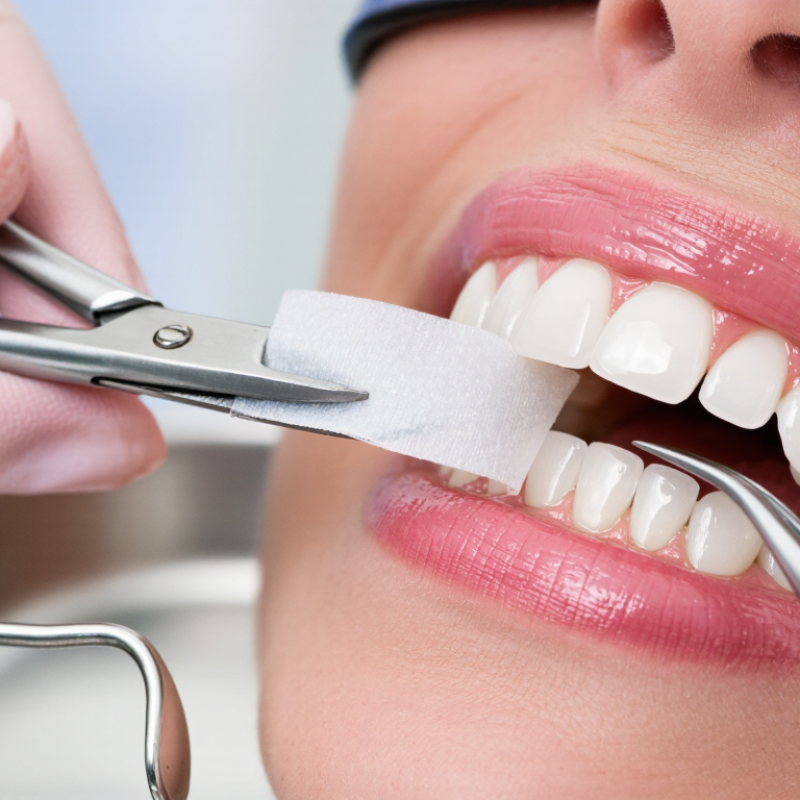
Dental Teflon Tape is a thin polytetrafluoroethylene material used for controlled protection and separation during selected dental procedures. Its smooth, non-stick surface helps prevent dental resin, temporary cement, or impression materials from bonding to nearby surfaces. In restorative dentistry, a clinician may place a small strip between adjacent teeth before bonding or composite placement. This creates a cleaner contact area and reduces unwanted material flash.
In implant and periodontal procedures, medical-grade PTFE materials can also serve as protective barriers or temporary covers. Their use depends on the product’s design, sterility, and clinical instructions. A dental professional might trim the tape with sterile scissors, adapt it around a healing site, and remove it carefully during follow-up care. The detail matters. Household plumbing tape is not an appropriate substitute.
Dental Teflon Tape is useful, but it is not a universal solution. It does not replace isolation, proper wound management, or careful instrument control. Some applications require a manufactured PTFE membrane rather than ordinary tape. That distinction is easy to overlook. Product labeling and clinical judgment should guide every use, especially near healing tissues or implants. Evidence and training matter more than convenience. Dentists should assess moisture, contamination, tissue condition, and removal risks before selecting it. Even a tiny folded edge can interfere with a restoration or irritate delicate tissue. Its value comes from precise placement, not simply from the material itself.
What Is Dental Teflon Tape Used For?
Dental Teflon tape is made from polytetrafluoroethylene, or PTFE. Its friction coefficient can approach 0.04 under controlled testing. ASTM D1894 data shows that friction changes with load, surface finish, and moisture. Therefore, 0.04 is a useful reference, not a guaranteed clinical value.
In dental procedures, PTFE tape can create a smooth, non-stick barrier around restorative materials. Clinicians may use it to protect adjacent teeth, separate composite layers, or assist soft-tissue management during selected procedures. Its low surface energy helps materials resist sticking. This can make removal cleaner and reduce accidental bonding. Clinical reviews on PTFE membranes in implant therapy also describe useful barrier properties, especially when tissue exclusion is required. However, tape thickness, sterility, and handling quality affect performance. It is not automatically suitable for every treatment. That assumption needs questioning.
Tips: Choose medical-grade PTFE intended for dental use. Keep the field dry and isolated. Cut a clean piece with sterile instruments. Avoid leaving loose fragments beneath restorations or tissues. Check the manufacturer’s clinical instructions and local infection-control requirements. The friction number alone is not enough. Surface pressure matters, too. In practice, careful adaptation usually matters more than laboratory precision.
| Property or Use | Typical Information | Dental Relevance | Important Consideration |
|---|---|---|---|
| Material | Polytetrafluoroethylene (PTFE), commonly called dental Teflon tape | Provides a chemically stable, low-surface-energy material for selected dental procedures | Only products intended and packaged for dental or clinical use should be placed in the oral cavity |
| Coefficient of friction | Approximately 0.04 under commonly cited dry sliding test conditions | Allows the tape to slide over instruments or surfaces with relatively little resistance | The actual value varies with load, speed, surface finish, temperature, and lubrication |
| Implant screw-access protection | A small amount may be placed over an implant abutment screw before restorative filling material is applied | Creates a removable barrier and helps prevent restorative material from locking into the screw-access channel | The access channel must remain sealed with an appropriate restorative material afterward |
| Blocking out undercuts | Can be adapted as a temporary spacer or block-out material in selected clinical and laboratory procedures | Reduces unwanted engagement of impression, provisional, or restorative materials with an undercut | The tape should be stable, trimmed, and removed completely when the procedure is finished |
| Temporary separation layer | Used in some workflows as a thin, non-sticking barrier between PTFE and selected dental materials | Helps simplify removal of temporary materials or protect a defined surface during fabrication | Compatibility must be confirmed because PTFE is not a bonding surface for most dental resins |
| Chemical resistance | PTFE is resistant to many acids, bases, solvents, and moisture at ordinary clinical temperatures | The material generally remains inert when used as a short-term barrier in an appropriate procedure | Chemical resistance does not make every tape sterile, biocompatible, or suitable for prolonged tissue contact |
| Moisture behavior | PTFE absorbs very little water and is generally non-wetting | Supports use as a temporary moisture-resistant separator or protective layer | A dry, clean field is still required for bonding, cementation, and restorative procedures |
| Thermal stability | Solid PTFE is commonly rated for continuous service near 260°C, depending on grade and design | Provides a broad temperature margin for many room-temperature dental applications | Do not infer sterilization suitability from the polymer's thermal rating; follow the product instructions |
| Surface adhesion | Very low surface energy; most dental materials do not bond strongly to untreated PTFE | Makes the tape useful when easy separation or retrieval is desired | It should not be used where reliable adhesion or structural reinforcement is required |
| Common physical form | Thin, flexible white tape or strip that can be cut and adapted | Can conform to narrow access channels and small irregular surfaces | Thickness, width, tensile strength, and packaging vary by product and intended use |
| Clinical handling | Use a clean, appropriately sized piece and avoid leaving loose fragments in the mouth | Supports controlled placement and complete retrieval after the temporary function is complete | Use only under the direction of a qualified dental professional and according to the product's instructions for use |
Dental PTFE tape is a medical-grade material made from polytetrafluoroethylene. It creates a smooth, non-stick separation layer. It is not automatically suitable for every procedure.
Clinicians may use it around restorative materials, between composite layers, or near adjacent teeth. It can also support soft-tissue management in selected procedures. The exact use depends on the treatment.
A small piece covers the screw head inside an implant access channel. Composite is placed above it. The tape helps prevent composite from locking into the screw recess.
The clinician can remove the composite and PTFE layer more carefully. This exposes the screw head for inspection, tightening, or replacement. Without a barrier, hardened composite may fill the channel deeply.
No. It mainly provides a removable separation layer. It does not replace proper sealing, bonding, or restorative procedures. Calling it a universal sealant would be misleading.
PTFE absorbs very little water and resists swelling in saliva. Its chemical structure also resists many acids, bases, solvents, and oral fluids. Still, moisture control remains important.
The field should remain clean, dry, and properly isolated. A sterile instrument should cut a small, clean piece. The tape should fit over the screw without excessive pressure.
Overpacking can reduce composite thickness and affect the bite. Loose tape may shift during restoration. Not too much tape.
No. A reported friction value is only a laboratory reference. Load, surface finish, moisture, thickness, and handling can change performance. Practical adaptation often matters more than numerical precision.
The clinician should inspect the channel, margins, bite, and required imaging. The selected material must match the clinical situation. Inert does not mean risk-free.
Dental Teflon Tape is a thin polytetrafluoroethylene (PTFE) material used in dentistry as a temporary barrier and spacer. Its very low friction coefficient, close to 0.04, allows it to slide smoothly into small spaces, while its chemical inertness and resistance to moisture help it remain stable in the oral environment. These properties make it useful when clinicians need to protect or isolate an area during restorative procedures.
For implant restorations, dentists may place Dental Teflon Tape into the screw access channel before covering it with composite material. The tape is carefully positioned, compressed to create a stable base, and later removed when access to the screw is required. However, PTFE tape is intended only as a temporary sealing material. It does not replace gutta-percha or other materials designed for permanent root canal filling, so its use should remain limited to appropriate clinical applications and professional handling.
